


Dryland Pasture
Dryland Pasture
All-grass hay and forage mix for non-irrigated ground receiving 14"–20" of annual rainfall.
Our Dryland Pasture mix is formulated to produce the highest quality all-grass hay or forage pasture for areas that receive 14”-20” of annual precipitation. This mix should provide maximum gain for your livestock in dryland areas.
Couldn't load pickup availability
Select your land size and seeding method to see your suggested seed quantity
How much do I need?
25 lb per bag
Best use
Highest quality all-hay or forage-pasture areas. Provides maximum gain for livestock in dryland areas.
Mix details
Seeding details
- Drill rate
- 15–18 lbs/acre
- Broadcast rate
- 20–25 lbs/acre
- Annual rainfall
- 14–20" a year
Drilling puts seed at a consistent ¼–½" depth and uses less of it. Broadcasting is fine on smaller or rougher ground. Bump the rate and harrow or pack afterward for seed-to-soil contact.
- Kill the competition Spray out or till existing vegetation. Weeds and old sod take the moisture your seedlings need.
- Firm the seedbed Work the ground, then pack it. A boot print should sink no more than ¼".
- Seed shallow Drill at 15–18 lbs/acre, ¼–½" deep. Broadcast at 20–25 lbs/acre and harrow lightly.
- Time it for moisture Dormant seed in late fall, or go as soon as ground is workable in spring.
- Rest it the first year Let the stand root down before cutting or grazing. Clip weeds high if needed.
- Graze or cut from year two Leave 3–4" of stubble and rotate stock so the stand can recover.
What mix should I buy?
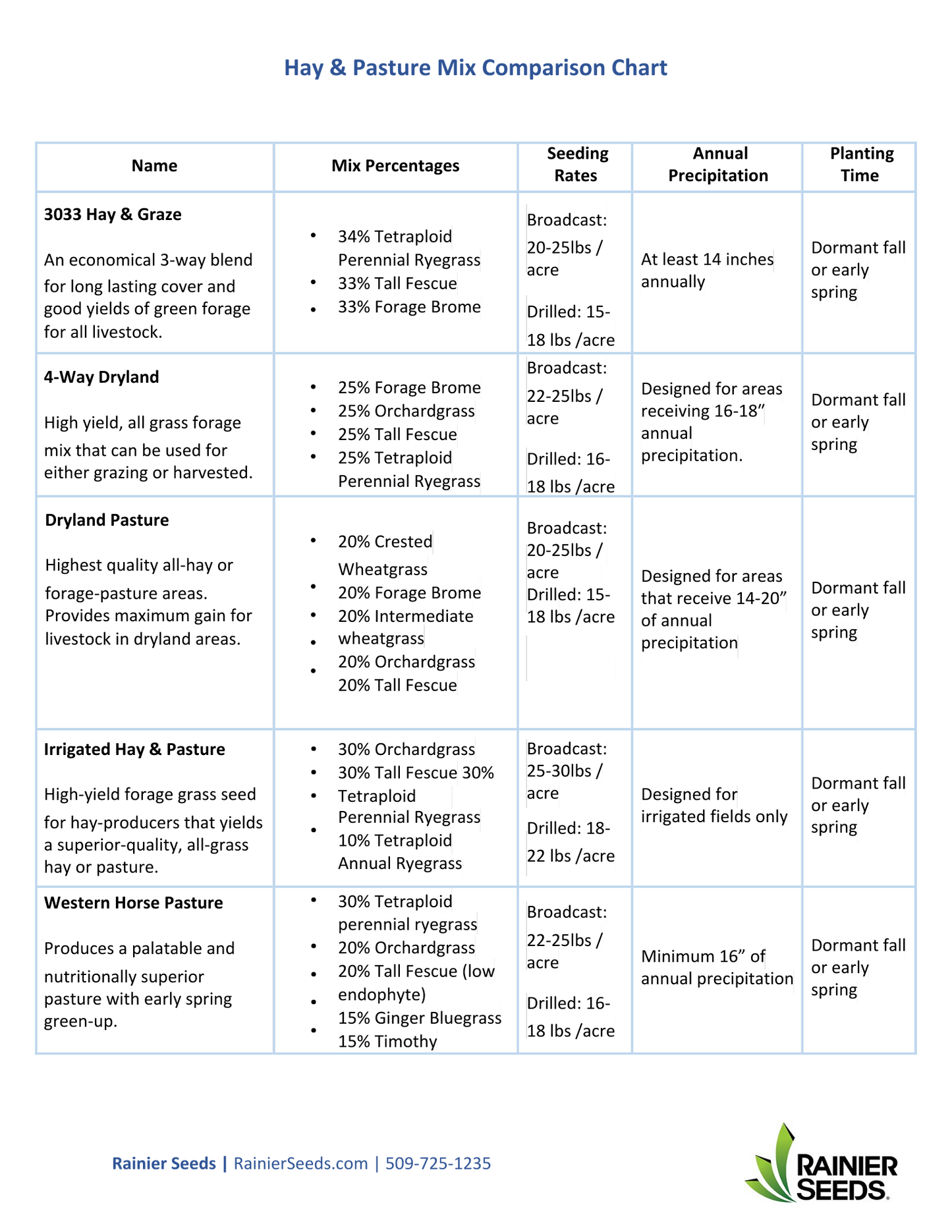
Compare every hay & pasture mix with our comparison charts below
Shipping & returns
Shipping
Free standard shipping on all seed orders within the contiguous United States, with no minimum order. Seed ships from Davenport, WA.
Processing takes 1–2 business days. After that, allow 4–10 business days for standard shipping or 7–13 for economy. You will get a tracking number by email once your order is on its way.
Bulk seed is heavy and may need special handling in transit. If your order arrives damaged, contact us within 7 days of delivery with photos and we will make it right. Read the full shipping policy.
Returns
You have 30 days after receiving your item to request a return. To be eligible it must be unopened, in its original packaging, and in the same condition you received it.
You are responsible for the cost of shipping the seed back to 1404 4th Street, Davenport, WA 99122. We issue a refund for the full invoice total. To start a return, email rainierseeds@rainierseeds.com. Read the full refund policy.
- Ships in 1–2 business days
- Free shipping on all online orders
- 30-day returns
- Blended and bagged in Washington



Frequently Asked Questions
Buy Dryland PastureDrilled at 15–18 lbs/acre, one bag covers roughly 1.4–1.7 acres. Broadcast at 20–25 lbs/acre, about 1–1.3 acres. Use the calculator above the Add to cart button to size your order.
Late fall (dormant seeding, after soil temps drop below 40°F) or early spring as soon as the ground can be worked. Both let the seed use stored winter moisture.
Give it a full season to establish. Light grazing or a high clipping late in year one is fine once plants resist a firm tug; regular use starts year two.
Yes. It is all-grass with no legumes, and the tall fescue is a low-endophyte variety.
Not reliably. Below 14" we recommend a native or crested wheatgrass-based rangeland mix. Call us and we will blend one for your site.